

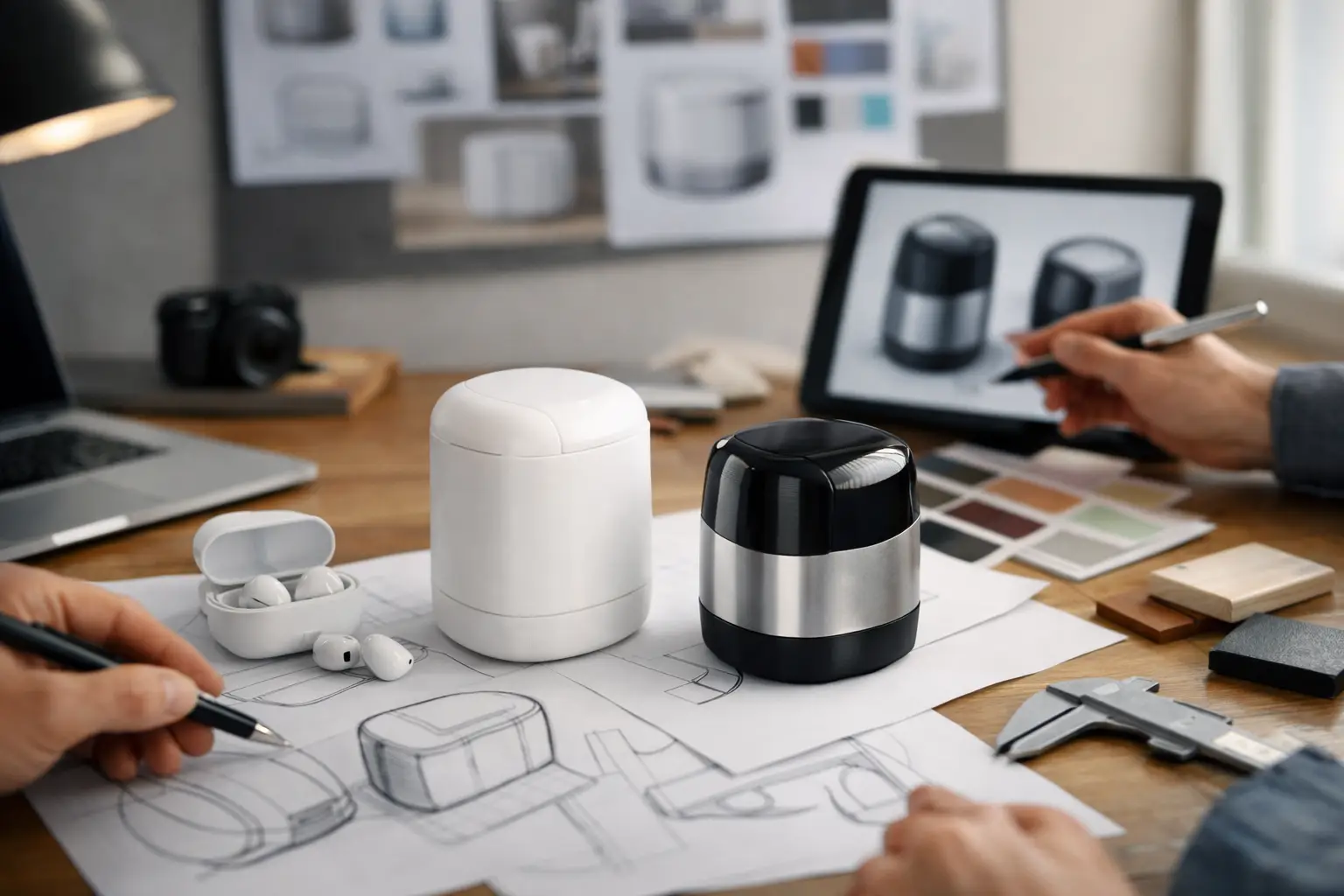
A promising hardware idea can fail long before production begins. It may solve the wrong user problem, require an unrealistic battery size, depend on fragile mechanisms, or look compelling in a rendering while being impossible to tool at target cost. That is why asking what is concept development in design is more than a vocabulary exercise. It is a business-critical question for any team moving from an opportunity to a physical product.
What Is Concept Development in Design?
Concept development in design is the structured process of turning an initial product opportunity into one or more credible product directions that can be evaluated, tested, and advanced into engineering. It connects user needs, business objectives, industrial design, technical architecture, and manufacturing realities before a team commits significant time and capital to detailed development.
For a physical product, a concept is not just a sketch or a polished image. It is an early but reasoned proposal for how a product should work, feel, look, and be built. It may define the user interaction, form factor, internal component layout, material direction, charging approach, display or control strategy, serviceability, and the major technologies required to deliver the intended experience.
The objective is not to prove every dimension or release production-ready files. The objective is to reduce uncertainty early enough that the next investment is based on evidence rather than enthusiasm.
Why Concept Development Matters for Hardware
Software teams can often revise an interface after release. Hardware changes become progressively more expensive as CAD models mature, prototypes are ordered, suppliers are engaged, and tooling is cut. A concept that ignores a connector location, heat path, antenna clearance, assembly sequence, or user grip may trigger costly redesign once those constraints become visible.
Concept development puts those constraints on the table while change is still relatively fast. It gives founders and product leaders a way to answer practical questions: Is the value proposition clear? Does the product fit the intended user and environment? Can the required electronics and mechanisms fit inside the desired enclosure? Can it reach a viable target cost? What must be proven in the next prototype?
This stage also prevents aesthetics from becoming disconnected from performance. A slim medical device may need enough internal volume for battery capacity and thermal management. An outdoor digital product may require a different approach to sealing, cooling, mounting, and daylight readability than an indoor consumer device. Good concepts make those trade-offs explicit.
How Concept Development in Design Works
The process varies by product maturity and technical risk, but it typically moves from definition to exploration, selection, and early validation. The strongest programs keep industrial designers, mechanical engineers, electronics specialists, and business stakeholders in the same conversation from the start.
Start with the problem, not the enclosure
A concept development effort begins by clarifying what the product must accomplish. This can include user research, stakeholder interviews, market and competitive review, technology evaluation, and an audit of existing intellectual property or proof-of-concept work.
The resulting product brief should identify the primary user, use environment, core job to be done, commercial priorities, and measurable requirements. For example, a field instrument may need to operate with gloves, survive repeated drops, run for a full shift, and be readable under direct sun. Those conditions shape the concept more meaningfully than a generic request for a “modern” product.
Requirements should distinguish between non-negotiables and preferences. A mandated sensor, regulatory pathway, retail package size, or launch price creates hard boundaries. Preferences such as premium feel or minimal visual complexity still matter, but they must be balanced against the technical and commercial realities.
Generate multiple directions
Once the opportunity is defined, the team develops several concept directions rather than falling in love with the first idea. Early exploration can include rough sketches, storyboards, user scenarios, ergonomic studies, architecture diagrams, layout studies, and quick physical mockups.
Each direction should make a distinct argument. One may prioritize compactness, another durability, and another an exceptional interaction model. The goal is not to produce superficial variation in color or styling. It is to test materially different approaches to the product’s form, function, and value.
For connected products, concept work often includes preliminary decisions about displays, inputs, LEDs, sensors, charging, wireless communication, and the user journey through software. The industrial design must anticipate these elements, while electronics and software teams assess whether the intended experience is technically achievable.
Evaluate against real constraints
A concept becomes useful when it can be challenged. Teams compare directions against criteria such as user value, differentiation, ergonomics, technical feasibility, reliability, manufacturability, target cost, timeline, and brand fit.
This evaluation is rarely a simple scorecard. A premium consumer product may justify a more complex assembly if the experience creates clear market value. A high-volume product may require a less ambitious geometry to protect tooling cost and yield. A startup pursuing clinical validation may prioritize stable function and traceable requirements over cosmetic refinement in an early phase.
The right choice depends on the product strategy. What matters is that the decision is visible, documented, and supported by the people responsible for delivering it.
Build just enough to learn
Early prototypes are often the fastest path from opinion to evidence. Foam models can evaluate scale and grip. 3D-printed enclosures can test fit, access, and assembly assumptions. Breadboard electronics or functional proof-of-concepts can expose power, sensing, wireless, or thermal challenges. Appearance models can assess the visual language with customers, investors, or internal teams.
No single prototype answers every question. A beautiful appearance model may reveal nothing about durability, while a functional electronics rig may bear little resemblance to the final product. Concept development plans validation around the uncertainties that carry the most risk.
What a Strong Concept Development Package Includes
A well-executed concept phase produces decision-ready material, not just attractive presentation boards. Depending on the project, the package may include a refined product brief, user and market insights, product architecture, multiple concept directions, selected concept rationale, preliminary CAD, component-layout studies, material and finish direction, interaction principles, and a prototype or validation plan.
It should also identify open issues. If the product needs a custom PCB, a high-output battery, a sealed housing, or a novel moving mechanism, those items should be flagged with a clear plan for feasibility work. Hiding uncertainty creates false confidence. Defining it creates an engineering roadmap.
For commercial stakeholders, concept development should support a stronger business case as well. It can inform development budgets, production volumes, supplier conversations, funding discussions, and a realistic path to launch.
Common Mistakes That Weaken Product Concepts
The most common mistake is treating concept development as a styling exercise. Form matters, but form without a credible technical and manufacturing path is simply a rendering. The opposite mistake is allowing engineering constraints to dominate before the user experience has been properly explored. Products win when both disciplines inform each other.
Another problem is selecting a direction too early. Teams under pressure often choose the first concept that looks finished, then spend months trying to force the architecture to comply. Early exploration is comparatively inexpensive. It is the right time to test alternatives, question assumptions, and discard weak paths.
Teams can also overbuild prototypes. An early model does not need production materials, final finishes, or every feature if the immediate question is whether users can operate the product safely with one hand. Focused learning cycles preserve budget and improve speed.
Finally, concept development can fail when nobody owns the decision criteria. Founders may focus on differentiation, engineering may focus on feasibility, and operations may focus on cost. All are valid concerns. A disciplined process brings them together before the project enters detailed design, where disagreement becomes more expensive.
When to Bring in a Cross-Disciplinary Team
A single discipline can generate useful ideas, but complex hardware benefits from integrated thinking early. This is especially true when a product combines custom electronics, embedded software, moving parts, demanding environmental requirements, regulatory considerations, or high-volume manufacturing goals.
At SurfaceID, concept development is designed to connect industrial design ambition with the practical work required to make a product real: mechanical architecture, PCB constraints, prototyping, assembly strategy, tooling considerations, and production planning. That connection helps teams avoid the handoff gaps that occur when design, engineering, and manufacturing are treated as separate projects.
The best time to start is often before the solution feels fully defined. A clear customer problem, a business objective, and a willingness to test assumptions are enough to begin shaping a product direction that can survive contact with users, engineers, and the factory floor.
A bold product idea deserves more than a convincing image. Give it a concept built to be questioned, tested, and carried forward into production.