

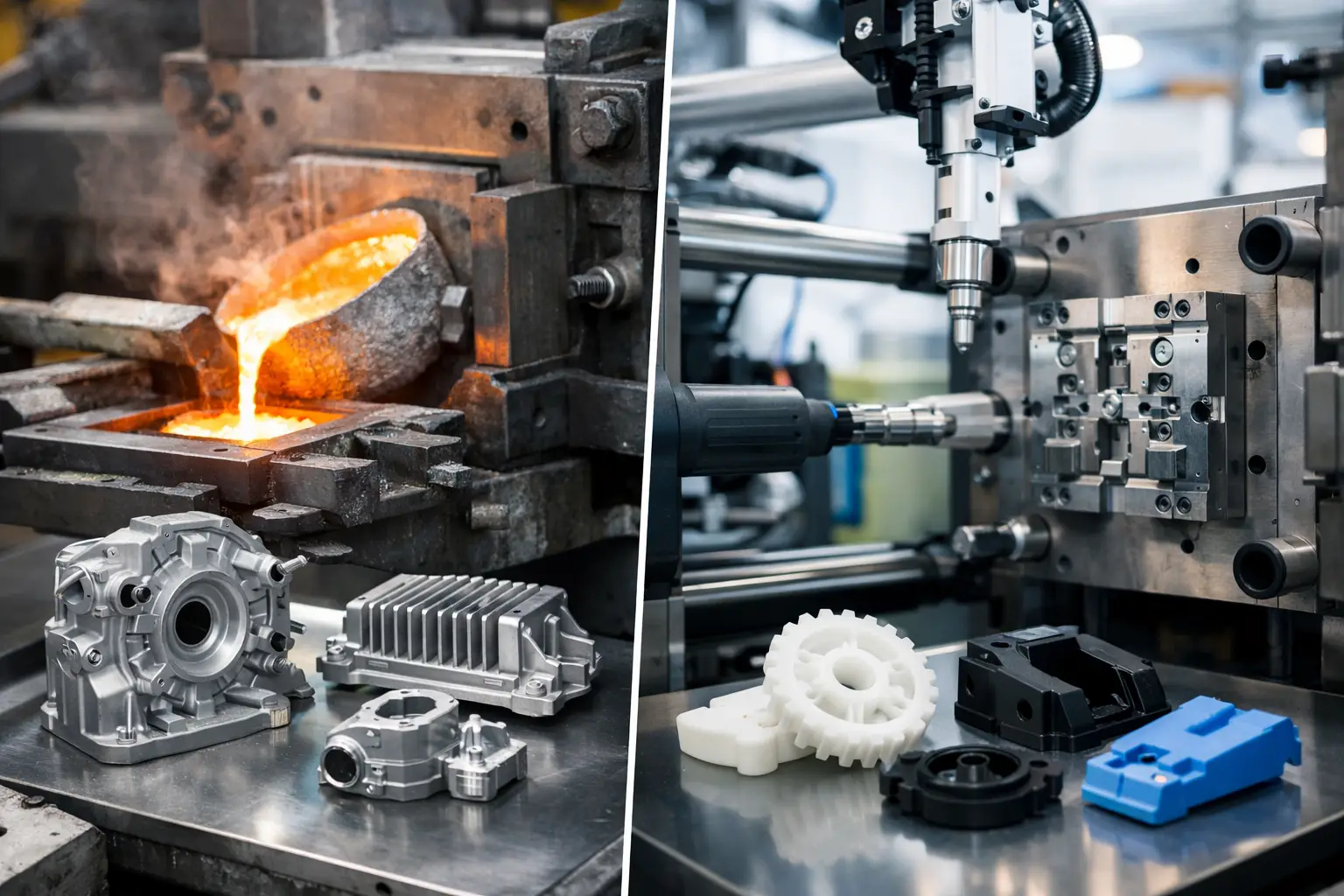
A housing that feels premium, survives years of use, protects sensitive electronics, and can be produced at scale is not created by choosing a process from a comparison chart. In the die casting vs injection molding decision, the right answer starts with what the part must accomplish for the user, the assembly, and the business.
For product teams moving from prototype to production, this choice has consequences well beyond appearance. It affects unit cost, tooling investment, part geometry, thermal performance, finish options, assembly strategy, certification requirements, and the speed at which a product can reach market. Die casting and injection molding are both high-volume manufacturing processes, but they solve fundamentally different material and engineering problems.
Die Casting vs Injection Molding: The Core Difference
Die casting forms metal parts by forcing molten alloy into a hardened steel die under high pressure. It is commonly used with aluminum, zinc, and magnesium alloys. The result is a rigid metal component with excellent dimensional repeatability and the potential for detailed features, thin walls, and refined surface finishes.
Injection molding forms plastic parts by injecting molten polymer into a steel or aluminum mold. Depending on the resin, the finished part can be flexible, impact resistant, chemically resistant, electrically insulating, translucent, lightweight, or suitable for demanding environmental conditions. Commodity plastics, engineering resins, thermoplastic elastomers, and fiber-filled materials all expand the design space.
The distinction matters because material selection comes first. If the product needs a metal enclosure for structural stiffness, heat dissipation, electromagnetic shielding, or a premium tactile experience, die casting may be the right production path. If it needs low weight, electrical insulation, integrated clips, soft-touch features, color variety, or complex nonstructural geometry at scale, injection molding often has the advantage.
Start With Product Requirements, Not Process Preference
Teams sometimes gravitate toward die casting because metal communicates durability, or toward injection molding because plastic tooling is familiar. That shortcut can create an expensive redesign later. The better question is: what must this component do inside the complete product?
A die-cast aluminum enclosure can provide a strong mounting platform for a display, battery, PCB, and connectors while also moving heat away from internal electronics. It can be a compelling option for an outdoor digital device, scientific instrument, transit hardware, or industrial controller. However, metal is electrically conductive, heavier than most plastics, and may require secondary machining where precise threads, flat sealing faces, or critical bearing interfaces are needed.
An injection-molded enclosure can integrate snap fits, living hinges, wire-routing features, gasket channels, light pipes, textured grips, and cosmetic surfaces directly into one part. For a handheld medical device or consumer product, that integration can reduce the total number of components and assembly operations. Yet plastic design must account for creep, UV exposure, chemical compatibility, flammability ratings, shrinkage, and the possibility that a highly loaded feature will fatigue over time.
Material behavior should be evaluated against the actual use case. A product exposed to salt spray, cleaning agents, sunlight, vibration, drops, or wide temperature swings may need a different answer than a device used indoors on a desk.
Geometry and Design Rules Shape the Decision
Both processes reward designs that respect manufacturing physics. Die casting requires draft so the part can release from the die, uniform wall sections where practical, and careful management of thick areas that can create porosity or shrink-related defects. Sharp inside corners should be avoided because they concentrate stress and complicate metal flow. Features such as ribs and bosses are possible, but their layout must support consistent filling and cooling.
Injection molding also requires draft, balanced wall thickness, and sensible transitions. Thick plastic sections cool more slowly and can cause sink marks, voids, or warpage. Ribs are commonly used to add stiffness without creating a heavy wall section. Undercuts can be molded with slides or lifters, but every mechanism adds mold complexity, maintenance demands, and cost.
The difference is in what each process makes easy. Injection molding is particularly effective for integrated functional details. Die casting can produce highly stable structural forms and fine metal details, but it is less forgiving when the design calls for deep, intricate internal geometry or extensive undercuts.
Tolerances Are Often an Assembly Question
Neither process should be described as universally more precise. Achievable tolerances depend on part size, geometry, material, tool quality, process control, and the critical feature itself. Large molded plastic parts can move with temperature and moisture. Die-cast parts can vary because of thermal contraction and alloy behavior, and some surfaces may need machining to meet exacting requirements.
The practical approach is to identify critical-to-function dimensions early. These may include a display opening, connector alignment, lens seating surface, gasket compression land, heat-sink interface, or PCB datum system. Then design the part and manufacturing plan around those requirements rather than applying tight tolerances everywhere. Over-specifying tolerances drives cost without improving product performance.
Tooling Cost, Unit Cost, and Production Volume
Both die casting and injection molding require purpose-built tooling, which means each has a meaningful upfront investment. Tooling is not simply a purchase to approve at the end of development. It is a production asset that should be engineered alongside the product.
Die-casting tools must handle repeated exposure to molten metal and high injection pressure. They can be expensive, especially for larger parts, multi-cavity tools, or designs with slides and demanding finish requirements. Secondary operations such as machining, deburring, impregnation, coating, or threaded insert installation can raise the cost of a finished die-cast component.
Injection-molding tool cost varies widely based on part size, resin, number of cavities, surface finish, side actions, and expected production life. A simple single-cavity tool may be economical for an initial launch, while a hardened multi-cavity production tool represents a larger commitment designed for high output. The molded part itself can be very cost-effective at volume, particularly when the design consolidates several components into one.
Production volume matters, but it is not the only financial variable. A lower-cost part that requires extra fasteners, shielding, thermal components, assembly labor, or warranty repairs may cost more at the product level than a more expensive housing that eliminates those needs. Evaluate total landed cost, not just the quote for one component.
Performance Factors That Commonly Decide the Outcome
Heat management is a frequent tipping point. Aluminum die casting is often selected when electronics generate enough heat that the enclosure must act as a thermal path. Plastic is generally insulating, although specialty thermally conductive compounds exist. Those materials can be useful, but they introduce their own trade-offs in cost, flow behavior, mechanical properties, and finish.
EMI and electromagnetic compatibility also influence enclosure design. Metal housings can provide effective shielding when grounding and interfaces are engineered correctly. Plastic enclosures may need conductive coatings, metalized surfaces, shielding cans, gaskets, or internal metal structures. For connected products, this decision should involve mechanical, electrical, and compliance teams early.
Weight can point in either direction. Plastic is usually the lighter option, which benefits portable equipment and shipping costs. But a die-cast component may allow thinner structural sections or replace several stamped, machined, and fastened parts. The final assembly, not the raw material density alone, determines the meaningful weight comparison.
Aesthetics deserve the same disciplined analysis. Injection molding supports molded color, texture, high-gloss surfaces, and soft overmolding. Die casting can be powder coated, painted, plated, anodized in certain aluminum applications, or left with a technical metal appearance. The desired look should be validated with production-representative samples, because a prototype finish does not always predict a scalable finish.
A Better Development Path Before Committing to Tooling
Before authorizing production tooling, validate the architecture with prototypes that answer the highest-risk questions. CNC-machined aluminum can help assess structural layout, thermal behavior, and the physical feel of a metal enclosure. Machined, 3D-printed, or bridge-molded plastic parts can test ergonomics, fit, snap features, assembly access, and user perception. These prototypes are not perfect substitutes for production parts, but they expose problems while changes are still affordable.
A manufacturability review should examine draft, wall thickness, parting lines, gate locations, ejector placement, cosmetic surfaces, tolerance stack-ups, material certification, finishing, and assembly sequence. If the product includes electronics, assess antenna performance, grounding, heat flow, ingress protection, connector loading, and service access at the same time. A housing is rarely just a housing.
This cross-disciplinary work is where SurfaceID helps product teams reduce the distance between an attractive concept and a buildable commercial product. Industrial design, mechanical engineering, electronics development, prototypes, and production planning need to reinforce one another before tooling locks in major decisions.
The strongest choice is the one that makes the whole product easier to manufacture, test, assemble, use, and support. Put the real product requirements on the table early, challenge assumptions with prototypes, and let the manufacturing process earn its place in the design.