

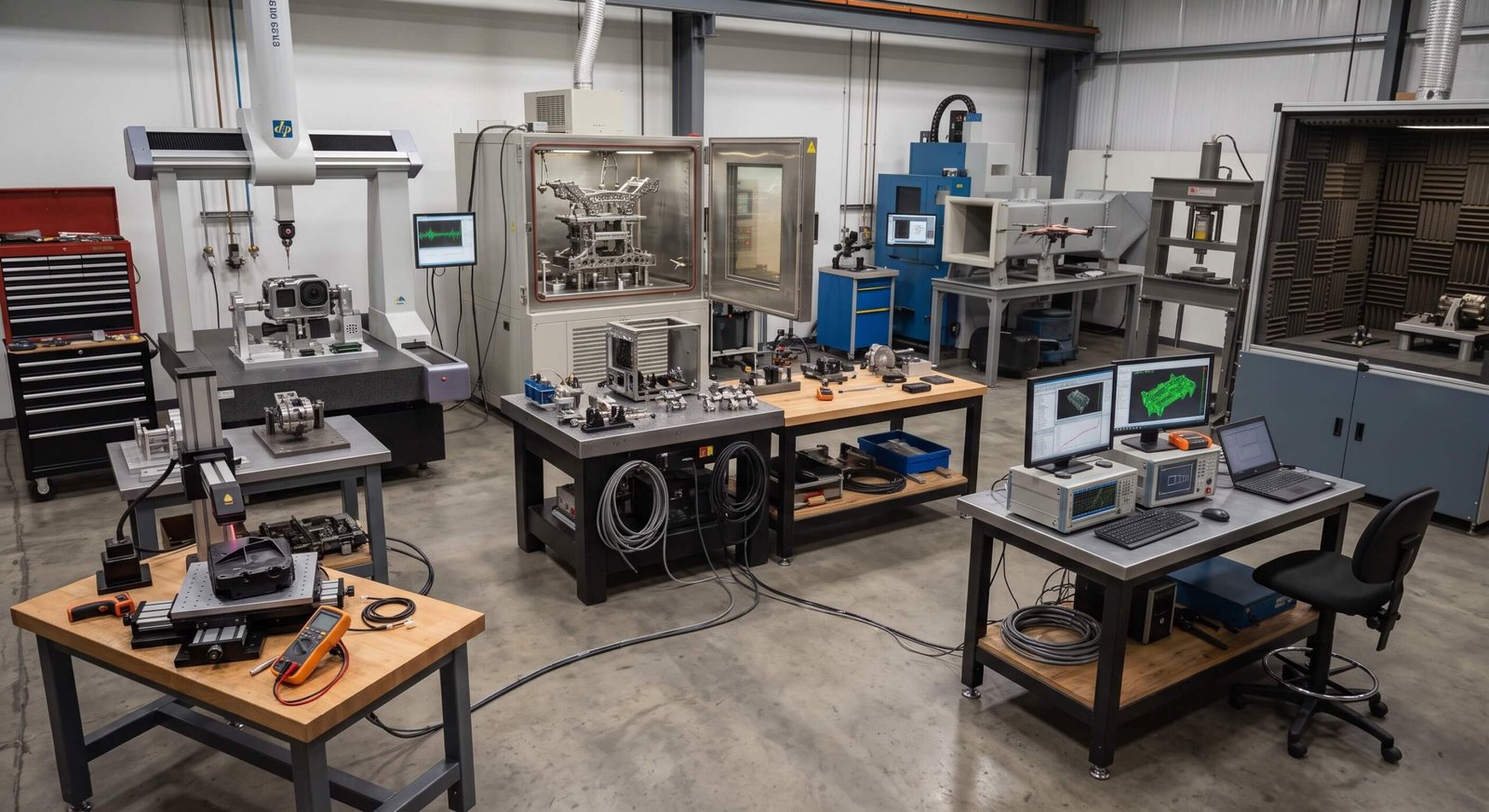
A prototype that powers on is not necessarily a product that is ready to build, sell, or support. Functional prototype testing methods are how product teams expose the gap between a promising demonstration and a dependable commercial device. The goal is not to prove that every feature works once on a workbench. It is to generate evidence that the product will perform under real user behavior, real environmental conditions, and real manufacturing constraints.
For founders and product leaders, that distinction changes the development conversation. Instead of asking whether a prototype is finished, ask what decision the prototype is meant to support: Should the team freeze the enclosure architecture? Is the battery capacity adequate? Can a technician assemble the product repeatedly? Does the interface prevent use errors? Each question needs a test designed to answer it.
Start with the risks that can derail the product
Testing becomes expensive when teams treat it as a final checkpoint. The stronger approach is to connect every prototype build to the highest-risk assumptions in the product requirements. Those risks may be technical, human, commercial, or operational.
A wearable medical device, for example, may need early proof that its sensor maintains contact across different body types, that its charging system is safe, and that users can correctly position it without training. An outdoor transit display may need to demonstrate thermal performance, ingress protection, display readability, service access, and communications stability. Neither product benefits from waiting until a polished pre-production prototype exists before testing these fundamentals.
Create a test matrix before building. For each requirement, define the test condition, measurement method, pass criteria, sample size, owner, and resulting design decision. This creates traceability between a product claim, the prototype used to evaluate it, and the evidence needed to proceed. It also prevents teams from interpreting a positive result too generously.
The pass criteria should be concrete. “Easy to use” is not a criterion. “Eight of 10 first-time users complete setup in under five minutes without assistance” is. “Battery lasts a long time” is not a criterion. “Operates for 12 hours at the defined duty cycle after 300 charge cycles” is.
Core functional prototype testing methods
The right functional prototype testing methods depend on the product category and maturity of the design. A foam model may answer ergonomic questions, while a CNC-machined housing with production-intent electronics may be required to assess heat, vibration, wireless performance, or mechanical failure modes. The most effective programs use the lowest-cost prototype capable of producing credible evidence.
Bench testing verifies engineered performance
Bench testing measures whether subsystems perform as designed under controlled conditions. This is where teams validate electrical current draw, motor torque, sensor accuracy, charging behavior, thermal rise, wireless range, signal integrity, force, flow, light output, or timing.
Controlled does not mean simplistic. A useful bench test recreates meaningful operating states, including start-up, maximum load, idle periods, fault conditions, and repeated cycles. If an electronic product only works when connected to laboratory power and placed beside a development laptop, the test has not represented its actual use case.
Instrument the prototype wherever practical. Data logging can reveal intermittent resets, voltage drops, heat accumulation, or communication failures that observation alone will miss. Testing should also capture boundary conditions. Knowing that a mechanism works at nominal load is less valuable than knowing when performance begins to degrade and what protects the user when it does.
User testing reveals failures engineering alone cannot see
A functional prototype should be placed in front of representative users before industrial design and engineering decisions harden into tooling commitments. The objective is not to collect general opinions. It is to observe behavior against specific tasks.
Give participants a realistic scenario and ask them to use the product with minimal instruction. Watch where they hesitate, apply unexpected force, misunderstand feedback, or create workarounds. In physical products, small points of friction often become expensive problems: a connector that appears symmetrical but is not, an actuator with insufficient tactile feedback, a display obscured by glare, or an enclosure that cannot be opened by a service technician wearing gloves.
Functional user testing is especially valuable when hardware, firmware, and physical interaction are tightly connected. A button may electrically register every press yet still fail the experience because its travel is unclear. A status LED may operate correctly but convey the wrong meaning. A dispensing device may meet its mechanical tolerance while still causing users to spill material during refill.
Environmental and reliability testing exposes weak assumptions
Products leave the predictable conditions of the studio or lab. They get dropped, left in hot vehicles, exposed to rain, carried over rough terrain, charged with incompatible cables, and used repeatedly by people who have not read the instructions.
Environmental testing applies controlled stress to reveal how materials, assemblies, electronics, and software behave over time. The exact program depends on product requirements, but common evaluations include temperature cycling, humidity exposure, vibration, shock, drop testing, dust and water ingress, UV exposure, chemical resistance, and accelerated life cycling.
These tests are not only for highly regulated or industrial products. A consumer product with a cracked latch, warped enclosure, dimmed screen, or swollen battery can lose market trust just as quickly. The trade-off is that formal certification-level testing can be costly, particularly when designs are still moving. Early screening tests provide direction before the team commits to final laboratory qualification.
Design-for-manufacturing testing proves repeatability
A prototype can function perfectly when assembled by the engineer who designed it and still fail on a production line. Manufacturing-focused tests evaluate whether components locate correctly, fasteners can be installed consistently, adhesives cure in accessible areas, cable routing is repeatable, calibration is practical, and final inspection can identify defects.
This is where production-intent materials and processes begin to matter. A 3D-printed enclosure may validate size and user interaction, but it cannot reliably predict molded-part shrinkage, snap-fit durability, cosmetic appearance, or assembly variation. Likewise, a hand-soldered PCB can prove a circuit, but it does not prove that automated assembly, test programming, and field updates will work at scale.
Build a pilot run when the architecture is sufficiently stable. Then measure yield, cycle time, rework causes, part fit, cosmetic defects, and test-station outcomes. The purpose is to identify variation before variation becomes inventory, warranty exposure, and schedule pressure.
Build prototypes that answer the next decision
Not every prototype needs to look finished, and not every test needs a fully integrated device. Teams gain speed when they deliberately separate prototypes by learning objective. A mechanical rig can cycle a hinge thousands of times without the expense of full electronics. An electronics mule can evaluate power and communications before the final enclosure is available. A high-fidelity appearance model can test shelf presence and ergonomics without representing internal architecture.
Integration remains essential, but it should happen at the right time. A useful progression often moves from subsystem tests to integrated engineering prototypes, then to design verification builds and pilot production units. At each stage, the prototype should become closer to production only where the remaining risk demands it.
This approach also protects budgets. Building a highly finished prototype before verifying the underlying mechanism may create impressive images for a pitch deck, but it can delay the discovery of the issue that actually controls cost, performance, or manufacturability.
Turn test results into controlled iteration
A test report should do more than record pass or fail. It should document the setup, sample configuration, software and hardware revisions, data collected, anomalies observed, root-cause hypothesis, corrective action, and retest plan. Without version control, teams can accidentally compare results from prototypes with meaningful but undocumented differences.
When a test fails, avoid the instinct to patch the visible symptom immediately. Trace the failure across disciplines. A thermal problem might be caused by firmware duty cycle, enclosure geometry, battery selection, PCB layout, component placement, or a user behavior that was never anticipated. The fastest corrective action is not always the best commercial decision.
SurfaceID approaches this work as an integrated product-development problem because a functional prototype sits at the intersection of industrial design, mechanical engineering, electronics, embedded software, and manufacturing. Decisions in one discipline regularly create consequences in another. Testing makes those consequences visible while changes are still manageable.
Know when a prototype has earned the next investment
A functional prototype does not need to eliminate all uncertainty. It needs to reduce the uncertainties that matter at the current gate. Before moving toward tooling, certification, or production, the team should be able to explain which requirements have been verified, which have been partially demonstrated, which still rely on assumptions, and what those open items could cost if wrong.
That clarity gives investors, executives, and manufacturing partners a better basis for action than a polished prototype alone. The most valuable prototype is not the one that looks closest to a finished product. It is the one that makes the next high-stakes decision easier to make.